
A long read for Grade 4–7 teachers, principals, and anyone who cares that our kids are growing up without a working relationship with the wild.
A Grade 5 boy, a millipede, and a quiet realisation
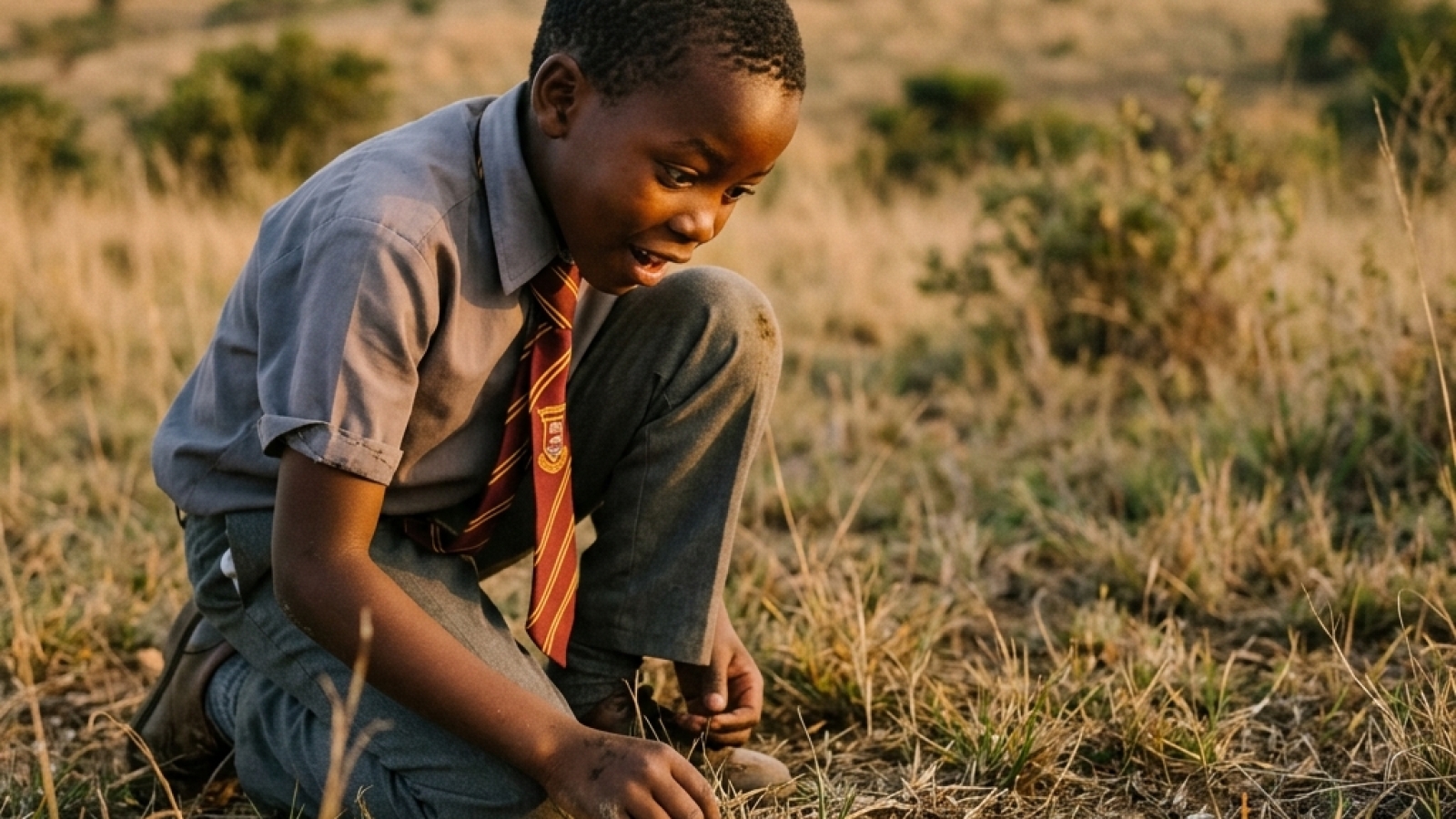
A teacher I work with took her Intermediate Phase class outside for the first time last year — not to a reserve, just to the strip of veld behind the school parking lot. Within three minutes, a boy was crouched over a millipede, completely still. He wasn’t scared. He was fascinated. When she asked him later what he was looking at, he said: “Miss, I didn’t know there were so many kinds of things.”
He’d never seen an insect up close that wasn’t a cockroach.
That moment captures something I’ve been watching unfold for 26 years of running outdoor environmental education programmes across South Africa. The problem isn’t that our kids don’t care about nature. Most of them care intensely. The problem is they don’t have access to it — not in any consistent, real, sensory way. And the gap isn’t random. It’s tracking exactly the lines you’d expect: quintile, geography, language, and what their parents can afford to do on a weekend.
This is the nature deficit. And it is one of the most important things happening in South African classrooms right now, even though almost nobody is naming it out loud.
What we mean by “nature deficit”
The phrase was coined by Richard Louv in Last Child in the Woods (2005). He wasn’t diagnosing a clinical disorder. He was naming a cultural condition: children across the developed world were growing up with structured schedules, screens, and indoor lives — and losing the everyday, unmediated contact with the natural world that previous generations took for granted.
The research that followed is robust and consistent. Children who spend regular, unstructured time in green spaces show:
- Better attention regulation and fewer behavioural issues in class
- Lower baseline cortisol (the stress hormone)
- Higher scores on tests of creative problem-solving
- Stronger immune function
Attention Restoration Theory, developed by Rachel and Stephen Kaplan, gives the mechanism: directed attention — the kind you use to sit in a classroom, follow a worksheet, stay on task — fatigues. Natural environments restore it, often within 20 minutes. That’s not a metaphor. It’s measured in salivary cortisol and continuous-performance tasks.
South African children aren’t an exception to this research. They’re an amplified version of it. Here’s why.
The South African version of nature deficit
Three forces compound the global pattern in our context:
1. Urban density and safety fear. In Johannesburg, Cape Town, Durban, and Pretoria, the majority of children live in densely built environments. For parents — especially in township areas — the calculus of “let the kids play outside” is genuinely dangerous. Many parents won’t allow unstructured outdoor play at all. This is not overprotectiveness. It is rational.
2. Screen saturation. South African children’s screen time has climbed steadily for over a decade. With loadshedding forcing children indoors even when parents do want them outside, the default for many families is now: screens inside, regardless of preference.
3. Curriculum pressure. CAPS is unforgiving on Intermediate Phase teachers. Marking, admin, parental communication, and the relentless march of content leave very little room for “extra” activities. Outdoor learning gets cut first because it is the easiest cut to defend on paper.
The result: a generation of South African children who know nature as a concept in a textbook, or as a faraway place they have no realistic way of getting to.
The equity gap is the part we don’t talk about
Here is the part of the nature deficit conversation that I think should sit with every outdoor education provider in the country — including my own business.
A Grade 6 class at a well-resourced Quintile 5 school in Johannesburg goes on an annual safari in Kruger. The kids arrive back able to identify a dozen trees, recognise bird calls, and write a credible field journal. They are forming a relationship with the natural world that will quietly shape their adult lives — the careers they choose, the way they vote, the way they think about conservation.
A Grade 6 class at a Quintile 2 school 30 kilometres away may have never left their suburb. Some of them have never seen a river, a frog, or a piece of veld that wasn’t a vacant lot. The natural world, for them, is genuinely abstract.
This is not just a feel-good problem. It is a science literacy problem, a mental health problem, an economic problem, and — over the long term — a conservation problem. The kids who will one day vote on water rights, biodiversity policy, and land use are currently growing up without the embodied knowledge that makes those issues feel real.
And the access gap tracks exactly the access gaps everywhere else: race, class, language, geography. A sponsored tour here and there doesn’t fix this. What fixes it is structural — schools returning year after year, teachers being equipped to extend the experience back in the classroom, and providers being honest about who they reach and who they don’t.
Why this matters for learning, not just for wellness
A common objection I hear from teachers and HODs is: “Outdoor learning is lovely, but we don’t have time for lovely. We have CAPS.”
Here’s the reframe that has worked for us across hundreds of tours: stop positioning the tour as a break from CAPS. Start building it as a CAPS delivery vehicle.
A well-designed wetland visit with Grade 6s doesn’t replace Term 2 Natural Sciences content — it is Term 2 content. The kids do real water quality testing. They catalogue macroinvertebrates. They map the river system using Geographic Information Systems concepts. They write scientific field notes. They come back with data they collected themselves.
That’s not enrichment. That is curriculum. When a teacher walks into the staff meeting with a post-tour pack that maps every activity to specific CAPS content, knowledge, and skills, the conversation shifts from “nice outing” to “core learning.”
The NAAEE Guidelines for Excellence — the international standards framework Ronel aligns OEEA’s tour design to — gives the language that makes this legible to principals and parents. When you can show that a Grade 6 wetland visit hits the same knowledge, skills, attitudes, and action outcomes as a recognised international framework, the principal doesn’t need to be persuaded. The HOD doesn’t need to be sold. The SGB doesn’t need a fight.
What teachers can actually do — without a massive budget
You don’t need a tour operator. You don’t need a budget. You don’t need permission from anyone but your HOD. Here are five moves that any Intermediate Phase teacher can make this term:
1. The 10-minute schoolyard audit. Give each learner a clipboard, a piece of string, and the instruction: count every different living thing in one square metre. Document what you see. Compare with another class. You’re doing real biodiversity science. You’re also doing CAPS.
2. Bring nature in. A classroom windowsill with one planted pot. A jar with tadpoles from a local pond (returned after two weeks). Silkworms for the Life Cycles strand in Term 1 — they’re quiet, cheap, and the kids lose their minds.
3. The schoolyard as a field site. Soil sampling in three different locations. A simple rain gauge. A bird count using BirdLasser (the free SA app) for 15 minutes before school starts. None of this requires leaving the property.
4. Find your local SANBI partner. South African National Biodiversity Institute runs free teacher programmes and has a garden in every major city. Most teachers don’t know this exists.
5. Pick one citizen science platform. iNaturalist, BirdLasser, FrogMAP, or the SANBI Botalista app. Pick one. Learn it. Get your class using it. Their observations become real data in a real national atlas.
Citizen science is the equity hack we already have
This is the move I get most excited about, because it flattens the access gap in a way almost nothing else can.
A Grade 6 learner in Tembisa, Soweto, or Khayelitsha — with nothing but a phone and an app — can submit a credible biodiversity observation to a global platform that researchers and conservation planners actually use. That same learner cannot afford a Kruger trip. But she can contribute a frog record to FrogMAP. That record will live in the atlas. Researchers will cite it. Her teacher will be able to say, in the staff meeting, that her class contributed to a national conservation dataset.
This is not symbolic. The BirdLasser atlases of the last five years have shown certain urban bird populations thriving in Johannesburg — only because ordinary citizens, including school groups, reported them. The data does not exist without the kids.
The deeper shift is in identity. The children stop being passive recipients of conservation messaging — “look after nature, kids” — and become the people generating the data that conservation depends on. They stop being tourists in the natural world. They become contributors.
From a schoolyard audit to a real school tour
Once a class has done the schoolyard audit, the windowsill project, the BirdLasser count, and the iNaturalist observations — they are primed for a proper field trip. And when they arrive at the wetland or the reserve, they arrive as young scientists with a working vocabulary, not as blank slates on a day out.
One well-designed school tour is worth more than ten worksheets. Not because it’s fun (though it is) — because the embodied, sensory, lived experience of standing in a wetland with a real ecologist teaching you how to read the water is the kind of learning the brain stores differently. Vygotsky’s old insight: real-world context accelerates concept mastery. We see it every tour, every term.
And here’s the honest bit: most teachers don’t have time to plan a tour from scratch. Risk assessments, parent comms, CAPS mapping, transport, catering, accessibility, medical plans — it’s a project, not a day out. That’s why tour operators exist. The good ones take that entire load off the teacher so the teacher can be a teacher, not a project manager.
What this looks like in practice
A Grade 6 class from a Quintile 3 school in Soweto joined us last year. Their teacher had never been on a school tour herself. She was nervous. We sent her the post-tour pack two weeks before — every activity mapped to CAPS content and skills, risk assessments done, parent comms drafted, halal catering confirmed.
The kids did water quality testing. They used iNaturalist for the first time. They submitted 47 verified observations to the global platform on day one. Their teacher cried at the closing circle.
That class is coming back next year. The teacher has now run the schoolyard audit twice. She’s added a windowsill garden to her classroom. She’s joined the BirdLasser challenge as a class.
This is what closing the nature deficit actually looks like. Not a one-off experience. A relationship. Year after year, building on itself.
If this resonated — here’s the next step
The full framework for designing CAPS-aligned, equity-aware nature-based learning experiences — including the schoolyard audit template, the citizen science platform list, the tour planning checklist, and the post-tour pack structure — is in the free ebook:
📘Crafting Curricula in the Wild: Developing Nature-Based Learning Experiences
Download the free ebook → https://oeeatours1.systeme.io/77fe9219
It’s the practical playbook I wish I’d had 26 years ago. Built specifically for South African Intermediate Phase teachers who don’t have time, budget, or permission to fail.
If you’re planning your 2027 school tour, the booking window is already open. The honest truth is that Term 3 is when Gauteng schools lock in their next year’s programme — if you want a Term 1 or Term 2 2027 tour, the conversation needs to happen in the next few weeks.
Authored by Ronel Harris — The School Tour Organizer. 27 years running outdoor environmental education programmes across South Africa. Founder of Outdoor Environmental Education Africa. Registered with the Department of Education. Aligned to the NAAEE Guidelines for Excellence.
Leave A Comment