
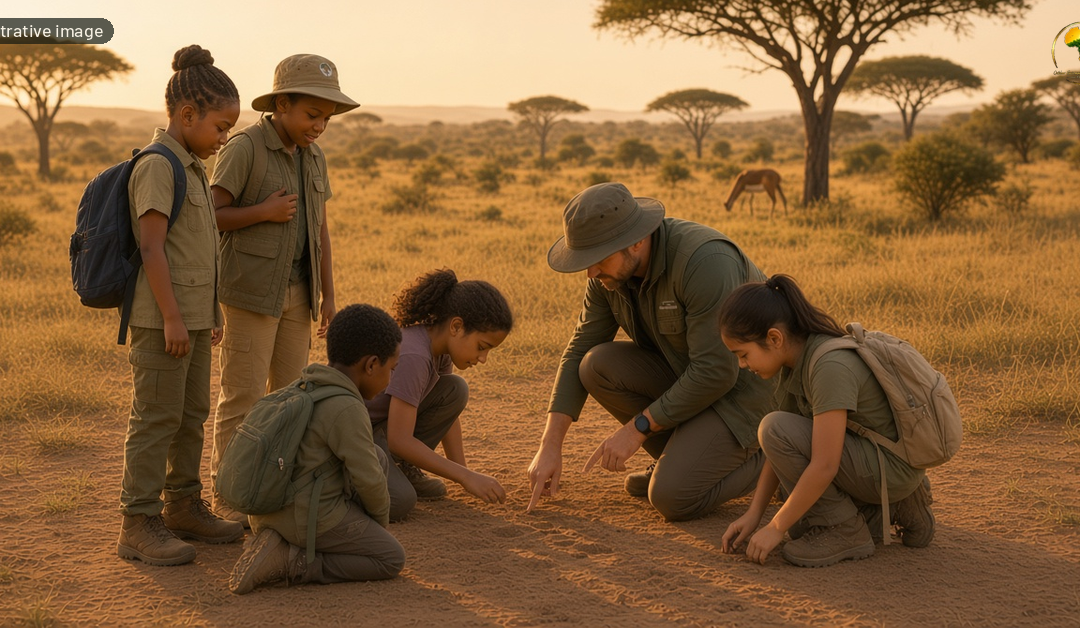
Planning a day outdoors with Grade 4–7 learners does not have to mean a long expedition or a folder of worksheets. What it does need is a clear CAPS-coded focus, a safety plan you trust, and a simple sequence that leaves room for curiosity.
This Teacher Tips guide will walk you through planning a CAPS-coded outdoor learning day — on the school grounds, nearby, or as part of a guided ecology-centered programme. It is written for Natural Sciences and Technology (Grades 4–6), Natural Sciences (Grade 7), Social Sciences (Geography), Intermediate Phase Life Skills, and Grade 7 Life Orientation.
Outdoor Environmental Education Africa (OEEA) has designed ecology-centered programmes for schools since 1999, and has worked with thousands of learners.
If you have been thinking about why time outdoors matters, we have written about that separately, including in Nature Deficit in South African Schools. This article stays with the how: how to plan the day, safely, and with a genuine CAPS-coded purpose.
Start with safety
Before you choose an activity or a destination, agree on the safety plan. You may find that a calm, shared briefing is what allows the rest of the day to feel adventurous rather than anxious — for staff, for learners, and for the school.
If you are planning the day as an OEEA tour, this is how our tours work:
- Schools must meet official supervision ratios: in primary schools, at least 1 adult for every 20 learners; in secondary schools, at least 1 adult for every 30 learners. Under Gauteng’s tour rules (Regulation 9), the School Governing Body must ensure at least 1 educator accompanies every 20 learners (or part thereof), regardless of school phase.
- There is 1 field guide per bus.
- Guides hold first aid certificates.
- The nearest medical facilities are established for each venue, with transport procedures in place.
- Buses and drivers are licensed, and are ratified by the school.
- Parent contact goes via the school.
Those arrangements sit with the school, not as a promise of direct contact with families at any hour. When you plan a day yourself, work with your principal on supervision, medical information held by the school, and how families will be reached, through the school.
Safety can also be part of the learning. Intermediate Phase Life Skills includes Dangers in and around water (Grade 4) and Basic first aid in different situations (Grade 6). A short briefing is enough. If water is part of the day, stay well back from banks and pools.
Keep the plan simple enough that every adult can repeat it: who is in which group, where you will walk, where you will gather, and what happens if someone feels unwell.
Choose one CAPS-coded focus
Build the day around one topic, not a tour of the whole year’s curriculum. Pick the CAPS topic you are already teaching that term, and turn it into one clear question learners can actually investigate outside.
The topic names below are taken from the public Curriculum and Assessment Policy Statement (CAPS) documents of the Department of Basic Education, and are used as published. OEEA describes its programmes as CAPS-coded; that is our wording, not a claim of departmental approval.
Natural Sciences and Technology, Grades 4–6 (official CAPS document): in the Life and Living strand, Grade 4 — Habitats of animals, or What plants need to grow; Grade 5 — Food chains, or Life cycles; Grade 6 — Photosynthesis, or Ecosystems and Food webs.
Natural Sciences, Grade 7 (official CAPS document): The biosphere, or Biodiversity, both in Life and Living.
Social Sciences — Geography (Intermediate Phase CAPS; Senior Phase CAPS): Grade 4 — Water in South Africa, or Map skills; Grade 5 — Physical features of South Africa, or Weather, climate and vegetation of South Africa; Grade 6 — Climate and vegetation around the world, or Map skills (focus: World); Grade 7 — Map skills (focus: Local maps), or Natural resources and conservation in South Africa.
Life Skills (Grades 4–6) and Life Orientation (Grade 7) (Life Skills CAPS; Life Orientation CAPS): Health and environmental responsibility in the Intermediate Phase, including, in Grade 4, Healthy environment and personal health: home, school and community; and, in Grade 7, Health, social and environmental responsibility.
Write one learning question in learner-friendly language — for example, “What does an animal need in this habitat?” Keep it small enough to explore in a morning.
For a wider survey of themes environmental school tours can support, see What Topics Do Environmental School Tours Cover?. The aim here is narrower: one topic, one question, one day.
Match the day to the grade
OEEA’s grade focus, which you can use as a planning guide, is:
- Grade 4: educational and fun, and close to home. A well-planned session on the school grounds or in a nearby park can be enough.
- Grade 5: educational CAPS-coded tours, with fun. Learners are ready for a slightly longer investigation, still with plenty of time to explore, notice and enjoy.
- Grade 6: Leader ID and development, alongside a CAPS-coded focus such as Ecosystems and Food webs or Photosynthesis. Give small groups a real, supervised responsibility, such as keeping a group together on a path.
- Grade 7: adventure with CAPS-coded learning. A longer walk or a new landscape can sit alongside Biodiversity or Natural resources and conservation in South Africa. The adventure is the setting; the learning question remains the spine of the day.
If the day takes learners further than the neighbourhood, OEEA works across three regions: Bushveld & Inland Regions; Highveld & Mountains; and Lowveld & Coasts. You do not need a distant destination for the day to count. Many urban schools, including in Gauteng, begin closer to home — a context we discuss in From Concrete Classrooms to Living Lessons.
A step-by-step plan for your CAPS-coded outdoor learning day
1. Name the learning question
Write the official CAPS topic and your one question at the top of a single planning page, and note what “good enough” evidence of learning will look like — a sketch, a short oral share, three written observations. That is enough. Do not design a full worksheet for the day.
2. Confirm safety and permissions with the school
Agree supervision, medical information, first aid, transport if you are leaving the grounds, and how parent contact will run via the school. Departmental application and approval remain the school’s responsibility; if you are touring with OEEA, we assist with the necessary supporting documents, and the safety arrangements described above are planned with your school. Share the plan with every adult who will be present.
3. Choose the setting
Match the setting to the question and the grade. Grade 4 is often best close to home. A Grade 7 group may be ready for a fuller day in one of the three regions, with a field guide. Wherever you go, review the gathering point, shade, toilets, water, and a clear boundary. Avoid steep or unstable ground.
4. Plan a simple sequence, not a packed timetable
A day that works usually has five movements: a short safety briefing; the learning question; observation in small, supervised groups; a little recording — a sketch, a labelled diagram, a few notes; then a share, a reflection, and a careful close. Leave more time for observing than for writing. You may notice that learners remember what they handled, heard and asked about, long after a clipboard has been packed away.
5. Keep activity ideas short
These are starting points only, not full tasks or workbooks:
- Grade 4, Habitats of animals: In two marked patches (under a shrub and in open grass), learners note what an animal would need there: food, water, shelter. A simple sketch is enough.
- Grade 5, Food chains: Learners identify one producer and two consumers they can actually see, and later arrange them as a short food chain back in class.
- Geography, Grades 5–6: Learners describe the plants around them and how those plants meet the day’s sun, wind or dryness.
- Grade 6: A quiet ten-minute watch on one plant — light, visiting insects, the soil beneath — for Photosynthesis or Ecosystems and Food webs. For Leader ID, give pairs a supervised role for a defined stretch of the day, then a brief reflection.
- Grade 7, Biodiversity: In a marked plot, learners count how many different kinds of plants they can distinguish. A sketch map with a key supports Map skills (focus: Local maps). A short conversation about care of the place can support Natural resources and conservation in South Africa.
- Life Skills / Life Orientation: A closing circle on leaving the place as you found it.
6. Prepare learners — and follow up in class
The day before, share the learning question, the safety rules, and what to wear and bring (hats, water, closed shoes). Teach two or three words they will need — habitat, producer, biodiversity — so the field is not the first time they hear them. The day after, give the topic a short home in class: a food chain on the board, a display of sketches, or a map completed from memory. Learners do not need a full workbook for the day to have done its work.
A teacher’s checklist
Use this as a single-page check before the day:
- CAPS subject, grade and official topic name noted, with one learning question.
- Safety plan agreed with the school: supervision, first aid, medical information, and parent contact via the school. Departmental application and approval remain the school’s responsibility.
- If travelling with OEEA: official supervision ratios, field-guide arrangements, licensed buses and drivers ratified by the school, and nearest medical facilities with transport procedures, confirmed with the school. OEEA assists with the necessary supporting documents.
- Setting chosen to match the grade (Grade 4 close to home; Grade 7 may travel further), with gathering points and boundaries reviewed.
- Simple day sequence written: brief, question, observe, record, share, close.
- Short activity idea prepared — not a full worksheet.
- Learners briefed the day before, and a follow-up lesson sketched for the return to class.
- Staff roles clear, including who leads the safety briefing.
A free guide for teachers, and the next step
If you would like more support in designing nature-based learning, download the free e-book for teachers, Crafting Curricula in the Wild: Developing Nature-Based Learning Experiences, by Ronel Harris, at https://oeeatours1.systeme.io/77fe9219. It is a practical starting point you can use at your own school, whether or not a tour is on the calendar.
You are also welcome to join the teachers’ Facebook Group, to enquire about a 2027 tour at reservations.oeea@gmail.com, or to visit www.oeea.co.za.
A CAPS-coded outdoor learning day, planned with safety first and one clear question at its heart, can be one of the most memorable — and most useful — lessons in your year. Leaving Footprints in Young Hearts for Nature and Wildlife.